

Memory techniques That Boost Learning and Recall
Memory techniques are essential tools for students professionals and lifelong learners who need to retain more information in less time. Whether you want to ace exams remember names give better presentations or retain complex concepts these strategies will help. In this guide you will find proven methods based on cognitive science practical ways to build a daily routine and simple tips to avoid common memory traps.
Why Memory techniques Matter
Good memory is not just for employees who must memorize facts or actors who must learn lines. It is a core skill that supports problem solving creativity and confidence. Memory techniques change the way your brain stores and retrieves information. Instead of relying on short term recall you create durable memory traces that are easier to access when you need them most.
Core principles Behind Effective Memory techniques
Before exploring specific methods it helps to understand three core principles that make memory techniques work. First repetition that is spaced over time strengthens memory. Second active retrieval improves long term retention more than passive review. Third meaningful connections and vivid imagery make material easier to recall. These principles support many of the techniques that follow.
Spaced repetition
Spaced repetition is a scheduling strategy that spaces review sessions so that information is revisited just as it is about to be forgotten. This approach makes study time more efficient. Use flashcards or a simple review calendar to plan sessions with increasing intervals. Modern apps can automate review schedules but you can also apply this method with paper cards and a small notebook. Spaced repetition is particularly effective for vocabulary formulas and key facts.
Mnemonic devices
Mnemonic devices turn abstract information into memorable patterns. Common formats include acronyms acrostics and rhymes. For example if you need to remember a list of steps create a short sentence where each word starts with the same letter as each item. The more personal or unusual the mnemonic the easier it will be to recall. Mnemonics work best when combined with imagery and retrieval practice.
Method of loci or memory palace
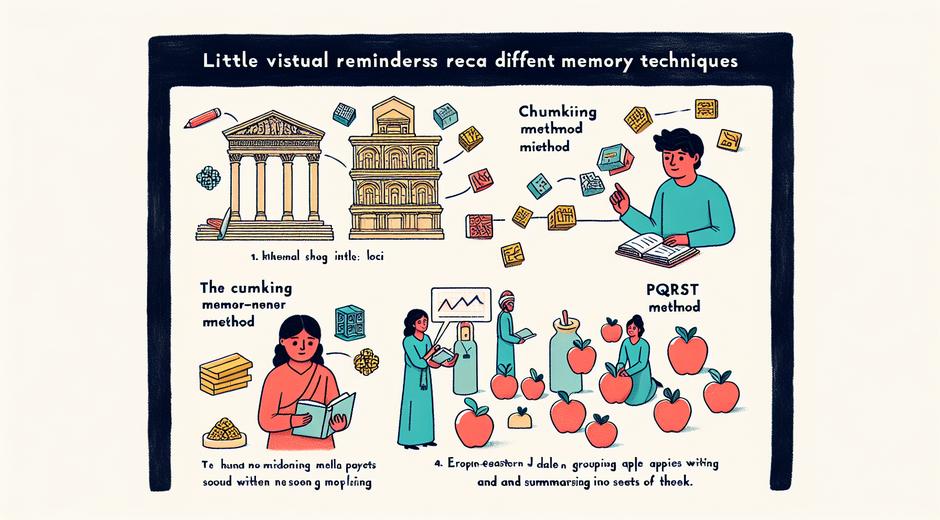
The method of loci sometimes called a memory palace uses spatial memory to organize information. You choose a familiar place such as a childhood home and mentally place items you need to remember along a path through that space. When you need the information you walk that path in your mind. This technique leverages the brain space mapping system to anchor abstract items into vivid locations. It is ideal for speeches lists and sequences.
Chunking and grouping
Chunking reduces cognitive load by grouping individual pieces of information into larger meaningful units. Phone numbers and bank numbers use this principle. Instead of memorizing ten separate digits you store three chunks that are easier to remember. Chunking works especially well with structured material where you can find natural groupings or hierarchies.
Visualization and association
Creating vivid images and linking new information to existing knowledge makes memory stronger. When you learn a new concept imagine a striking visual scene that represents the idea and then link that scene to something you already know. The more sensory and emotional the image the more durable the memory. This technique works well for abstract ideas because it transforms them into concrete memorable snapshots.
Storytelling and narrative
Humans are wired for stories. Turning a list of items into a short narrative connects them in a logical sequence that is easier to recall. For example when memorizing historical events place them into a story with causes and consequences. A brief story gives context and meaning which enhances long term retention.
Active retrieval practice
Testing yourself regularly is one of the most reliable memory techniques. The act of trying to recall improves memory strength more than rereading notes. Use practice quizzes flashcards and self generated questions. When you fail to recall an item try to reconstruct it from partial cues instead of immediately looking up the answer. This effortful retrieval is the most effective form of practice.
Interleaving and varied practice
Instead of practicing one skill until you master it then moving to the next alternate practice across related topics. Interleaving builds flexible memory by forcing your brain to discriminate between similar concepts. It may feel harder at first but long term retention and transfer of knowledge improve when you vary practice conditions and mix topics.
Sleep nutrition and movement
Memory techniques work best when your brain is healthy. Quality sleep helps consolidate new information. Proper nutrition with sufficient protein and healthy fats supports neurotransmitter function. Short periods of physical activity before study sessions increase blood flow and attention. Small lifestyle adjustments amplify the effectiveness of any memory technique.
Practical daily routine using Memory techniques
Build a simple routine that combines these techniques. Start each study session with a short review using spaced repetition. Then practice active retrieval with self testing. Use chunking to organize complex topics and visualization to create durable images. Finish with a brief summary that tells the story of what you learned. Rotate topics using interleaving and schedule reviews over days and weeks for maximum retention. For more study guides and skill building resources visit studyskillup.com where you can find structured plans and templates that match these strategies.
Using Memory techniques in real life
Memory techniques are useful beyond classrooms. Remembering names at networking events using a vivid association increases rapport. Memorizing key facts before meetings boosts confidence. Creative uses include remembering recipes steps and travel itineraries. Even personal topics such as meaningful dates or favorite songs can be stored more reliably with simple methods. If you are looking for playful memory cues for special occasions you may enjoy curated examples at Romantichs.com which offers creative prompts and ideas that can be adapted for memory practice.
Common mistakes and how to avoid them
Many learners rely on passive review or cramming which lead to quick forgetting. Avoid rereading without testing. Do not learn items in isolation without creating meaning. Resist the urge to multitask during review sessions. Finally do not neglect sleep and nutrition. Replace these habits with spaced review active retrieval and short focused sessions of high quality practice.
How to choose the best Memory techniques for you
Experiment with methods to find what fits your learning style. Visual learners often prefer imagery and loci based methods. Verbal learners may favor mnemonics and storytelling. A mixed approach usually works best. Track your progress by measuring how well you recall material after one day one week and one month. Adjust intervals and techniques based on results.
Conclusion
Memory techniques are practical accessible and powerful tools for anyone who wants to learn faster and remember more. By combining spaced repetition active retrieval visualization and healthy habits you can turn short term study into lasting knowledge. Start small pick one method to apply consistently and build your skills over time. With practice these techniques become second nature and transform the way you learn and perform.
Apply these approaches today and create a study plan that matches your goals. Use the tips in this guide to make every minute of study more effective and to build lasting memory that supports success in work study and life.